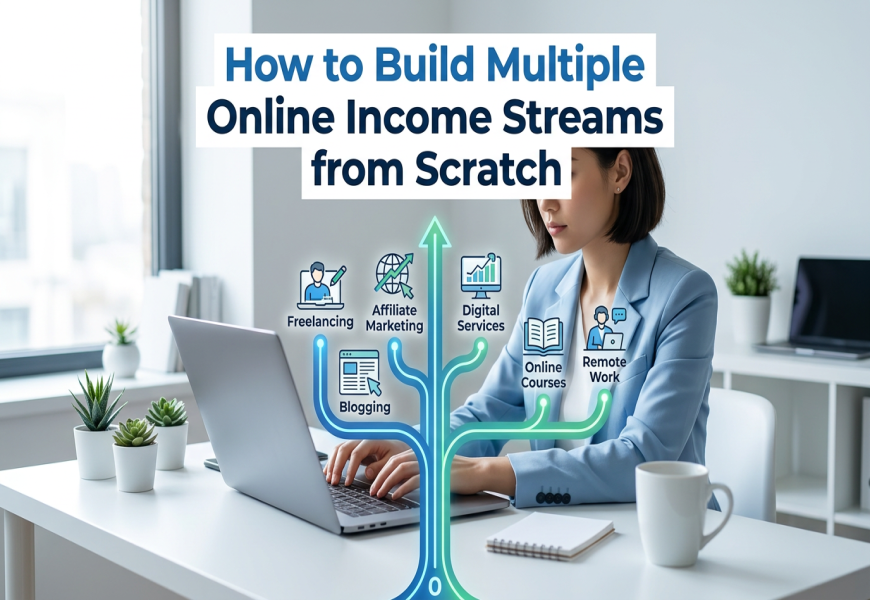
How to Build Multiple Online Income Streams from Scratch in 2026
How to Build Multiple Online Income Streams from Scratch
In the modern digital era, relying on a single source of income is one of the most significant financial risks an individual can take. Economic volatility, sudden industry layoffs, and shifting corporate environments have made financial diversification a necessity rather than a luxury. Building multiple online income streams from scratch has evolved into a highly viable strategy for individuals seeking genuine financial resilience, operational flexibility, and long-term career autonomy. Whether your objective is to supplement your current salary or completely replace a traditional 9-to-5 corporate job, the internet offers a vast ecosystem of scalable revenue channels.
However, transitioning into successful online entrepreneurship requires a structured approach. Many beginners fail because they scatter their energy across too many unverified projects simultaneously, leading to absolute exhaustion and zero financial progress. To secure sustainable digital wealth, you must carefully evaluate your existing competencies, analyze real market demands, choose compatible business models, and strategically scale separate assets over time. This comprehensive guide provides an actionable roadmap to construct, manage, and diversify your digital income portfolio successfully.
💡 The Multi-Stream Asset Framework
To build a secure, well-balanced digital presence, it is vital to understand how different business models perform regarding risk and scaling potential. Review this strategic allocation matrix:
Income Category | Initial Risk Profile | Scaling Velocity | Primary Digital Asset | Management Intensity |
Service-Based Gigs | Extremely Low Risk | Linear (Traded for time) | Freelance Portfolios & Client Contracts | High (Requires active daily execution) |
Asset-Based Publishing | Medium Risk | Exponential Growth | Authority Web Blogs & SEO Platforms | Medium (Requires consistent content updates) |
Product-Based Commerce | Medium Risk | Unlimited (Infinite scaling) | Downloadable Checklists & E-books | Low (Automated payment delivery systems) |
1. Auditing Personal Skills and Verifying Market Demand
Inventorying Core Competencies and Technical Talents
The foundation of any profitable online business relies entirely on the value you can provide to the marketplace. Your first step must be a transparent self-audit of your current capabilities. Take a piece of paper and list everything you can execute competently, ranging from professional talents like copy editing, graphic design, and software programming to administrative strengths like data sorting, project scheduling, and customer communication.
If you struggle to identify your standout capabilities, evaluate the common tasks coworkers, friends, or fellow students routinely ask you to handle. These community requests highlight your natural skill areas. Remember, you do not need to be a world-class academic expert to monetize a capability; you simply need to possess a clearer understanding of the subject than the specific customer base you intend to serve.
Aligning Personal Interests with Commercial Viability
While launching a project centered around a personal passion makes long-term consistency easier, passion alone cannot generate revenue if there is no commercial buyer interest. You must carefully verify that your specific area of interest contains a hungry target audience willing to spend money on solutions.
Utilize completely free analytical market tools like Google Trends, social media discussions, and active community forums to evaluate what consumers are actively searching for within your niche. Analyze the specific questions users are asking. The ultimate path to digital profitability lies exactly where your personal writing or technical skills collide with verified commercial market demand. Finding this intersection eliminates the risk of building a digital asset that nobody reads or purchases.
2. Researching and Auditing Online Opportunities Safely
Conducting In-Depth Competitor Analysis
Before deploying your first website or listing a service online, you must thoroughly audit your future competitors. Identify the top 5 intermediate providers or blogs already operating successfully within your targeted niche. Analyze their business layouts with a critical eye:
· What specific monetization models are they utilizing (contextual advertisements, affiliate links, or premium downloads)?
· How do they structure their written articles to engage their target audience?
· What visible gaps or user complaints are apparent in their comment sections or review boards?
Identifying these functional gaps allows you to modify your digital strategy, injecting your unique perspective and superior content to capture market share quickly.
Choosing the Optimal Digital Infrastructure
Different remote business models require distinct software platforms to operate efficiently. If you choose a service-based freelance path, establish high-quality profiles on reputable networks like Upwork and Fiverr. If your goal is to distribute downloadable assets or digital printable, utilize low-fee processors like Gum road or Etsy. For content publishers, establishing a self-hosted platform using flexible content management frameworks remains the gold standard, as it grants you absolute ownership over your readership data and ad integration parameters.
3. The Layered Scaling Strategy: Diversifying Methodically
The Single-Focus Execution Rule
The absolute biggest trap that destroys beginner entrepreneurs is trying to launch multiple complex income streams all in the same week. This chaotic approach dilutes your focus, leading to incomplete websites, sloppy client communications, and early psychological burnout.
You must enforce the single-focus execution rule: select one foundational income stream such as freelance copywriting or specialized virtual assistance—and dedicate 100% of your operational hours to mastering it. Work diligently until this initial stream becomes organized, predictable, and generates stable monthly revenue.
Leveraging Momentum for Passive Assets
Once your primary service-based lane is running smoothly on an organized schedule, you can safely use its capital and industry credibility to fund and build your secondary passive asset. For example, if you have built a successful freelance graphic design business, you can leverage that real-world authority to launch a specialized instructional blog or design a series of premium downloadable templates.
This layered approach allows the success of your first business stream to organically feed and scale your next asset, creating a highly resilient web of diverse revenue streams that protects your finances from sudden algorithm updates or market shifts.
4. Financial Literacy and Administrative Organization
Operating multiple online income assets requires a high level of administrative discipline and basic financial literacy. Treating your digital earnings like unstructured pocket money will quickly lead to financial disorganization, especially during tax seasons.
· Isolate your incoming corporate revenues by maintaining a separate digital ledger or business banking account.
· Utilize clean accounting spreadsheets to log every minor operational cost, from software subscriptions to website domain renewals.
· Regularly allocate a fixed percentage of your monthly net income exclusively for local tax compliances and business reinvestments.
Remaining organized behind the scenes ensures your digital ventures build a strong, professional foundation that scales smoothly as your traffic and client portfolios expand globally.
Frequently Asked Questions (FAQ)
1. How long does it typically take to establish multiple stable income streams?
The time required depends heavily on your daily time allocation, skill level, and chosen business tracks. Generally, a dedicated beginner can build their initial service-based income stream within 30 to 90 days. However, constructing deep, passive infrastructure like an authority blog or a digital product portfolio typically requires 6 to 12 months of continuous publishing and marketing before yielding substantial, automated profits.
2. Can I build multiple digital revenue streams with zero upfront financial capital?
Yes, absolutely. A significant portion of the modern digital economy can be entered using entirely free tools. You can write content on free blog layouts, design printable templates using Canva’s free tier, host instructional portfolios on public drives, and pitch global clients on major freelance marketplaces without spending a single dollar upfront. Your primary initial investment is your focused time and consistency.
3. What is the most effective strategy to manage time when tracking different income streams?
The most efficient methodology is Context Batching. Avoid jumping back and forth between different business tasks throughout the day. Instead, dedicate specific, isolated days or time blocks to individual assets. For instance, dedicate your Monday and Wednesday evenings exclusively to executing client freelance deliverables, and reserve your Saturday mornings entirely for creating content for your personal blog.
Disclaimer: The economic frameworks, operational blueprints, and platform comparative metrics presented in this article are designed strictly for educational and general informational purposes. Individual financial growth metrics vary heavily based on personal consistency, niche competition variables, technical proficiency, and global market fluctuations.
Share This
Latest Blog





Online Data Entry Jobs 2026
16 Sep 2026Popular Blog