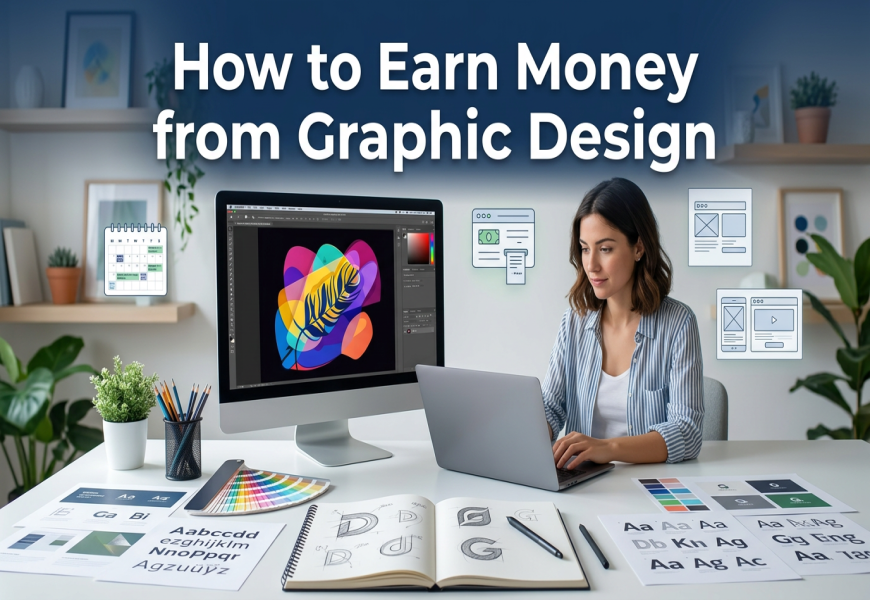
How to Earn Money from Graphic Design in 2026
How to Earn Money from Graphic Design: A Comprehensive Guide 2026
In today’s highly digitized marketplace, visual communication serves as the primary currency for brand identity, audience retention, and consumer conversion loops. From fast-growing mobile applications to global e-commerce storefronts, corporations spend millions of dollars annually to secure high-quality corporate assets that instantly capture public attention. This massive macroeconomic demand has transformed graphic design from a standard artistic hobby into a highly lucrative digital career asset. If you possess functional design competence, your creative skills can unlock multiple sustainable streams of online revenue.
Transitioning your design talents into a predictable business framework requires a strategic approach that balances creative output with sound commercial pricing models. Many independent designers struggle not from a lack of aesthetic ability, but because they fail to niche down, neglect back-end business contracts, or operate purely as generalists who trade hours directly for low payments. To scale your design earnings efficiently, you must build a portfolio centered around real business outcomes, master premium client onboarding loops, and diversify your workflows across active freelancing and automated passive asset licensing. This extensive guide provides an actionable, step-by-step roadmap to maximize your creative earning capacity safely.
💡 Industry Matrix: Design Specialization and Valuation Layout
To assist you in selecting the most profitable operational track within the global design marketplace, review this comprehensive metric breakdown:
Design Specialization | Core Software & Toolsets | Primary Target Clients | Average Market Project Valuation | Scalability Profile |
UI/UX App Architecture | Figma, Adobe XD, ProtoPie | Funded tech startups, mobile-first e-commerce apps. | $2,500 – $8,000 / Project | High (Transitions smoothly into agency models). |
Corporate Digital Branding | Adobe Illustrator, InDesign | Medium enterprise businesses, corporate service firms. | $1,500 – $4,000 / Package | Medium (Driven by premium localized contracts). |
Automated Templates | Canva Developer, Notion | Independent content creators, small digital stores. | Scalable (Passive Cash Flow) | Ultimate (Create once, sell infinitely online). |
1. Establishing a High-Value Foundational Asset
Selecting a Tight Specialization to Command Premium Rates
The single biggest operational error that stalls the financial growth of beginner graphic designers is attempting to serve as a broad generalist. Claiming you can design corporate logos, edit wedding videos, and layout book covers all in the same week dilutes your market authority and forces you to compete in crowded, low-paying entry tiers. Specializing in a targeted, technically demanding niche instantly removes you from the race to the bottom.
Clients facing high-stakes business launches do not look for cheap generalists; they actively search for niche specialists who understand their specific industry parameters. By focusing your energy entirely on a high-value sector—such as user interface optimization for financial technology applications or luxury minimalist packaging design for cosmetics brands—you can instantly command project fees that are 20% to 50% higher than general market baselines.
Building Case Studies over Raw Image Lists
A premium corporate client will never hire you based on a chaotic grid of detached images posted without context on social media. Your professional portfolio must read like a collection of data-driven Business Case Studies. For each sample project featured in your portfolio drive, structure your written text around a clean three-point narrative:
· The Commercial Challenge: Detail the exact operational struggle or aesthetic failure your client’s brand was facing.
· The Strategic Visual Solution: Explain your step-by-step design philosophy, software tool choices, and wireframe updates.
· The Tangible Business Outcome: Highlight the measurable metric success your design generated, such as a 20% boost in website conversion rates or a distinct lift in e-commerce checkout sales.
Keeping each case study around 300 words with clear before-and-after visual comparisons instantly proves to prospective corporate employers that you view design as a metric growth engine rather than a mere art cost.
2. Advanced Freelance Inbound and Outreach Frameworks
Enforcing Strict Value-Based Contracts
To shield your creative business from revenue losses and scope creep, you must establish professional contract boundaries before executing any project briefs. Move away from open-ended hourly billing structures for long-form creative campaigns, as this model penalizes you for working fast and efficiently. Instead, utilize Fixed Project Fees or Value-Based Pricing Matrixes where your compensation is directly tied to the final commercial impact you deliver to the enterprise.
Your legal design contracts must explicitly document the precise number of deliverables included, state a hard cap of two total refinement revision rounds, enforce a non-refundable 50% upfront down payment clause, and explicitly clarify that the legal copyright ownership of the raw vector design files transfers to the buyer only after the final invoicing balance has been settled in full.
Conducting the Three-Point Technical Cold Pitch
Do not rely entirely on crowded freelance job boards to secure high-paying contracts. Build a proactive outbound client acquisition loop by executing targeted cold emails to marketing managers at mid-sized firms weekly. Audit your target client’s current web presence, find a distinct design flaw, and construct a short, personalized note using the Three-Point Critique Formula:
1. Identify a visible, leaky conversion gap on their homepage banner or ad layout.
2. Outline an explicit, clean visual fix to optimize their mobile-first user experience.
3. Attach a direct link to your case study drive, offering a brief exploratory call to execute the upgrade.
This proactive, value-first outreach model bypasses platform transaction fees completely and establishes your authority from the very first interaction.
3. Diversifying Into Automated Passive Asset Streams
Creating and Licensing Downloadable Digital Templates
To build long-term financial stability, you must decouple your digital income streams from your active working hours. Scaling a passive design asset pipeline allows you to generate automated cash flows while sleeping. Utilize your creative expertise to design premium, highly adaptable formatting templates that everyday consumers and small business owners require to run their operations.
High-demand passive digital templates include customizable Canva social media marketing bundles, corporate presentation slide decks, customized digital icon packs for smartphone applications, and aesthetic tracking dashboard layouts built on Notion. Host these downloadable files on low-fee digital asset marketplaces like Creative Market or your personal Gumroad.com checkout store, allowing buyers to purchase and download your designs instantly around the clock.
4. Scaling Beyond Independent Execution
Once your independent freelance tracking board reaches absolute capacity, transition your business model from a solo designer into a small Visual Design Agency. Hire competent junior designers on a project-by-project contract basis via trusted networks to execute foundational layout tasks and raw asset scaling under your direct creative supervision. This structural shift allows you to focus your daily energy on top-level business strategy, client acquisition, and high-value value-based consultations, multiplying your operational delivery capacity and scaling your agency’s monthly net revenue into a substantial digital business asset.
Frequently Asked Questions (FAQ)
1. Which portfolio platform provides the best organic search discoverability for a new designer?
While maintaining a clean, self-hosted portfolio website is the gold standard for long-term branding and search engine optimization (SEO), beginners should parallelly publish their case studies on Behance and Dribbble. These massive creative ecosystems are routinely searched by international corporate recruiters, design agency directors, and funded tech startups looking for specialized remote talent, offering immediate organic visibility.
2. How can a beginner master advanced UI/UX design tools without spending money?
The modern e-learning workspace contains excellent free educational resources to build commercial software competence. You can download Figma completely for free under their introductory personal account tier and master its core functionalities—such as auto-layout systems, component packaging, and interactive prototyping loops—by following official structured video documentation libraries available online.
3. What is the most effective approach to pitching a client who asks for free spec work?
Never execute free custom design work or uncompensated draft assignments under the guise of an audition, as this devalues your industry authority. If a prospective client demands free spec designs, politely decline the request, re-direct their attention to the verified real-world metrics highlighted inside your live case study portfolio, and offer to execute a short, paid mini-project to safely test your professional workflow compatibility.
Disclaimer: The graphic design industry earning projections, platform regulations, and software metrics detailed in this article are designed strictly for educational and general informational purposes. Individual financial growth metrics vary heavily based on personal consistency, portfolio excellence, niche market competition parameters, and global commercial demands.
Share This
Latest Blog





Online Data Entry Jobs 2026
16 Sep 2026Popular Blog